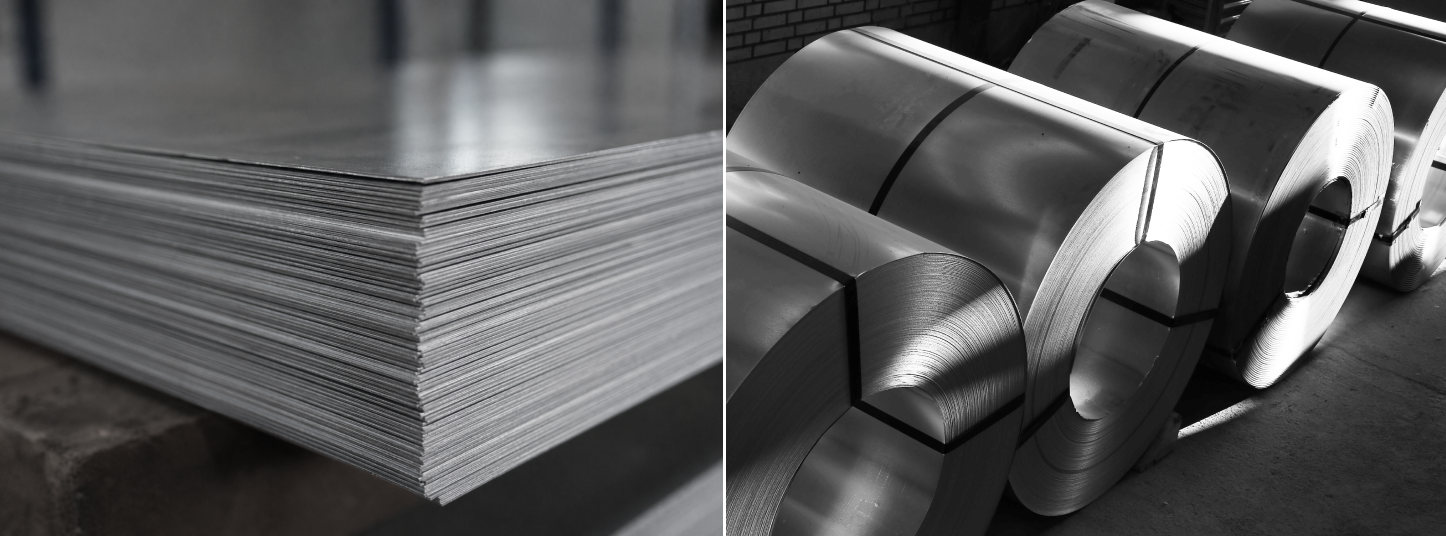
Coil or Sheet: How Much Is Metal Actually Costing You Every Year?
How much does sheet metal cost your operation each year, compared to buying coil metal and how much could you save by switching your raw material format? The answer depends on three things: your production volume, your available equipment, and your long-term goals. Let’s break it down.
If your production line cuts steel coil daily, or if you’re repeatedly restocking finished sheet, this article will help you calculate exactly where the money is going — and what can realistically change this quarter.
Coil Metal — The Choice for Manufacturers
When you buy metal in coils, you’re buying closer to the source — no supplier markup for pre-cutting, and no offcuts from fixed sheet dimensions.
The numbers speak for themselves:
- Price per ton is typically 10–20% lower than sheet
- Less material waste — you cut exactly what you need, at the length you need
- More compact for logistics — coils stack efficiently, reducing transport costs
- No joints or seams — continuous material, consistent quality across the entire run
Who Benefits Most From Coil Processing
Coil processing is the industry standard for manufacturers of:
- roofing profiles;
- corrugated sheets;
- HVAC ducting;
- guttering systems;
- cladding panels and sandwich panels.
Any production line running the same profile repeatedly benefits from coil input. The one requirement: you need equipment to uncoil, straighten, and cut the material — a decoiler, a straightening unit, and a cutting line.
Sheet Metal — The Choice for Workshops and Short Runs
Sheet metal has its place. It’s ready to use, easy to store on racks, and practical for one-off jobs, welding, or repair work. For small volumes or thick gauges, sheets often make sense.
But the cost structure is different:
- Higher price per square meter — you’re paying for processing the supplier already did;
- Fixed dimensions create offcuts when your product size doesn’t match the sheet;
- More manual handling per piece.
For high-volume production, these costs compound across every order.
The Cost Difference Doesn’t Disappear — It Gets Redistributed
The difference between coil and sheet doesn’t disappear. It’s redistributed — either into your supplier’s margin, or back into your own operational efficiency, provided you have the equipment to process coil in-house.
The question worth asking: on your current annual metal volume, what is the price difference between coil and sheet actually costing you?
Equipment for Switching to Coil — Stefa Processing Lines
Moving production from sheet to coil isn’t a matter of buying “one machine.” It requires a coil processing line — at minimum a decoiler, and, depending on your output needs, a recoiler for finished product.
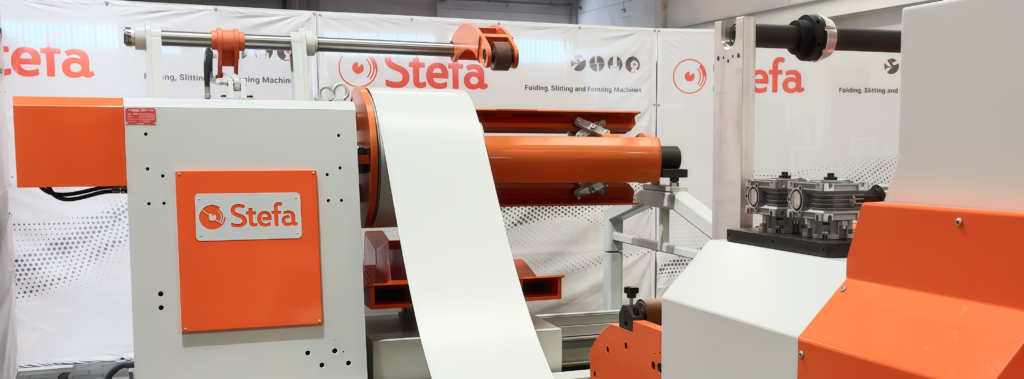
Stefa Decoiler
The Stefa decoiler unwinds the master coil of steel, feeding the metal as a flat, even strip into the next stages of processing — cutting, roll forming, or film lamination. It’s the first point in the line, and the stability of its operation determines the quality of the entire batch.
Stefa Recoiler
The Stefa recoiler performs the reverse function — rewinding processed metal back into a compact coil of the required weight and diameter. This is essential equipment for steel service centers that purchase material in large volumes and supply customers with the exact quantity needed for each order.
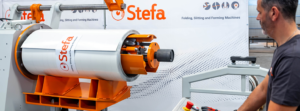
Together, a Stefa decoiler and recoiler give manufacturers and steel service centers the flexibility to manage raw material format on their own terms: buying cost-effective master coils and converting them into batches sized for the customer or for the next stage of production — without paying a supplier’s markup for sheet cutting.
Case Study — The LPB Coil Processing Line
A clear example of how a decoiler/recoiler setup performs in practice: the LPB coil processing line from Stefa.
The Challenge
Turn one large 10-ton steel coil into dozens of shipment-ready coils, sized to individual customer requirements.
The Solution
The LPB line converted a 10-ton steel coil into batches of 300 kg, 600 kg, or any other required weight — this is exactly how steel service centers create added value: purchasing material in bulk and supplying customers with the precise quantity their order calls for.
Watch the Stefa LPB coil processing line in action: https://www.youtube.com/
LPB Line Technical Specifications
- Processes steel coils up to 1.5 mm thick and 1500 mm wide;
- Line configuration includes a DH1000 decoiler, an LCS 1.5 protective film applicator, a 6-meter transfer table, a tensioning unit, and an EH1000 recoiler.
Modular, Fully Customizable Design
Stefa LPB lines are modular and fully customizable. Depending on production requirements, they can be configured for recoiling, slitting, longitudinal cutting, and other processes — helping manufacturers and service centers optimize material handling and increase operational flexibility.
Bottom Line — How to Calculate Your Own Savings
Before deciding whether to switch from sheet to coil, it’s worth answering three honest questions:
- What is your total annual metal volume?
- What share of that volume could realistically move to coil processing without limiting your product range?
- Do you already have the equipment to uncoil and recoil material a decoiler/recoiler or is that function currently being paid for through your supplier’s markup?
If the price gap between coil and sheet adds up to a meaningful sum on your annual volume, it’s probably time to run the numbers on a coil processing line such as the Stefa LPB coil processing line.