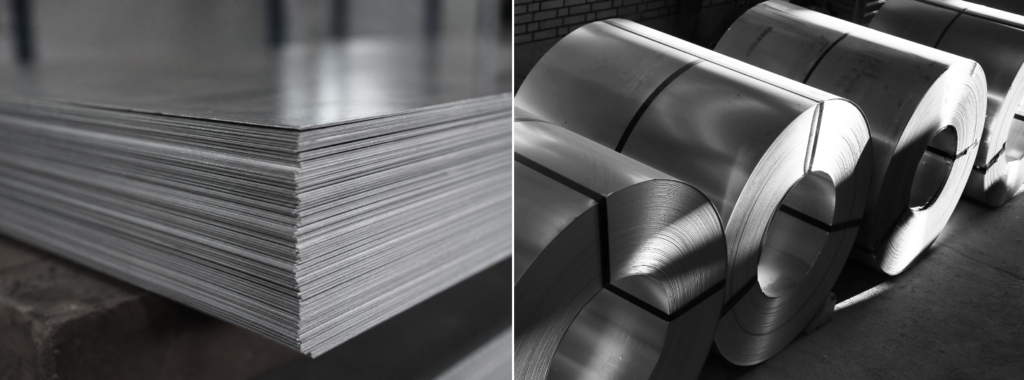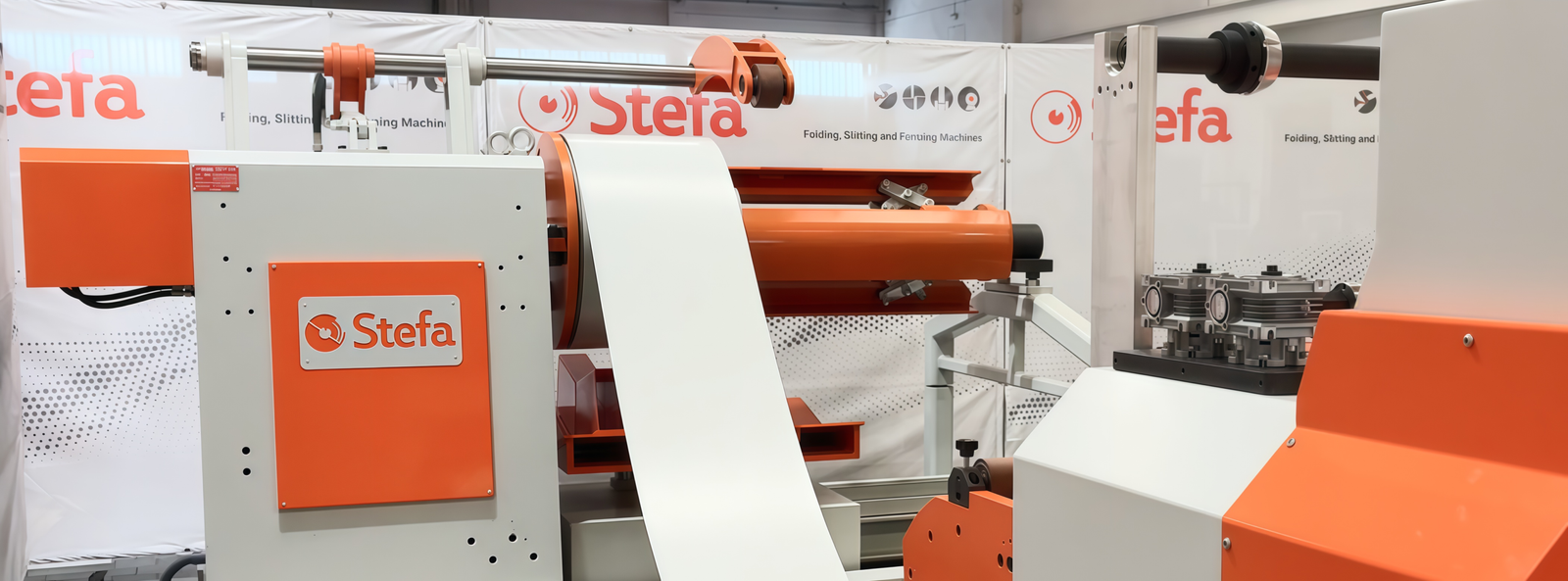
A decoiler holds a metal coil on a mandrel and controls safely its rotation so the sheet metal unwinds at a constant, even pace, feeding flat into a straightener or roll former without buckling or loop irregularities. The type of decoiler that fits your line depends on two things: how much coil weight and width you’re handling, and how much automation your operation actually needs. There are three main types: manual, motorized, and hydraulic each built for a different point on that scale. A fourth, related piece of equipment, the recoiler, runs the opposite process for lines that slit coil downstream.
Manual decoilers
Manual decoilers are the simplest and most cost-effective option. Speed is set by a disc brake rather than a motor, and the mandrel expands to lock the coil in place by hand. They’re the right choice when the operation doesn’t need full automation and cost-effectiveness matters more than feed speed and they still support multiple coil configurations without the overhead of sensors or drives.
Our DC6 is a manual decoiler rated up to 3,000 kg, handling coils up to 1,500 mm wide, with brake-controlled speed adjustment.
Motorized decoilers
Motorized decoilers automate the feed with a gear motor and sensor-based loop detection, removing the manual speed control and reducing operator intervention. They’re built for narrower coil widths and mid-range capacities the range most purlin, roofing and cladding profile lines actually run in.
Our DM Series covers this range across three capacities: the DM1.5 at 1,500 kg (400 mm width), the DM3 at 3,000 kg (800 mm width), and the DM5 at 5,000 kg (800 mm width). All three run fully automatic speed adjustment.
Hydraulic and motorized decoilers
Hydraulic and motorized decoilers combine motor-driven feed with hydraulic components for higher capacity and wider coils, with fully automatic speed adjustment throughout. This is where lines step up from mid-volume to heavy-duty production.
The DH500 handles coils up to 5,000 kg and 1,500 mm wide. The DH1000 goes further — up to 10,000 kg as standard, with a 15,000 kg configuration available, on coils up to 1,250 or 1,500 mm wide. It’s the choice for high-volume lines where uptime and coil-handling capacity are the limiting factor, not floor space.
They are equipped also with other elements like cradle lifting coils or clamping arms to help manage the heavier coils with speed and safety.
Recoilers: the equipment that works the other direction
A recoiler isn’t a type of decoiler — it’s the equipment that does the reverse job, rewinding processed, slitted coil back into neat, uniform rolls. It’s worth knowing about alongside decoilers because the two often sit on the same line: this matters for any operation running a slitting process downstream, where the output needs to leave as finished coil rather than flat stock.
Our EH1000 recoiler runs at speeds up to 80 m/min.
Decoiler and recoiler comparison table
| Model | Type | Max load capacity | Coil width | Speed adjustment |
|---|---|---|---|---|
| DC | Manual | 6,000 kg | up to 1,500 mm | Brake-controlled |
| DM1.5 | Motorized | 1,500 kg | 400 mm | Automatic |
| DM3 | Motorized | 3,000 kg | 800 mm | Automatic |
| DM5 | Motorized | 5,000 kg | 800 mm | Automatic |
| DH500 | Hydraulic and motorized | 5,000 kg | 1,500 mm | Automatic |
| DH1000 | Hydraulic and motorized | 10,000 kg (up to 15,000 kg) | 1,250 or 1,500 mm | Automatic |
| EH1000 (recoiler) | Hydraulic and motorized | – | – | up to 80 m/min |
How to choose the right decoiler type
Start with your coil width it narrows the field immediately, since the DM Series is built for 400–800 mm while the DH range handles up to 1,500 mm. From there, match capacity to the heaviest coil your supplier delivers, with some margin rather than running at the limit. Automation level is the last decision: manual works when volume is lower and cost-effectiveness matters most, while motorized and hydraulic units pay off once feed consistency and reduced downtime start affecting throughput.
Frequently asked questions
What’s the difference between a motorized and a hydraulic decoiler? Motorized decoilers use a gear motor for feed control and typically handle narrower coils at lower capacities. Hydraulic and motorized decoilers add hydraulic components to manage higher capacities and wider coils while keeping speed adjustment fully automatic.
Can I run a manual decoiler on a high-volume line? Technically yes, but manual speed control via disc brake becomes a bottleneck as cycle times shorten. Manual decoilers are best suited to lower-volume or multi-configuration operations rather than continuous high-throughput lines.
Does a wider coil always need a bigger decoiler? Not necessarily capacity, but width does narrow your options — the DM Series tops out at 800 mm, so anything wider needs to move to the DH range regardless of coil weight.
Do I need a recoiler if I already have a decoiler? Only if your line includes a slitting operation. A recoiler rewinds slitted output into finished coils; if your process ends with cut-to-length or profiled sheet rather than slit coil, a recoiler isn’t part of the setup.
Not sure which decoiler fits your coil range? Request a free equipment consultation with our technical team.